
Q&A: Driving the Pan-American Highway in a Camper Van
Q&A: Driving the Pan-American Highway in a Camper Van
Insights from a couple who completed this epic route in a Winnebago Revel.
By: Peter & Kathy Holcombe
After about six years of exploring North America full-time, we decided to downsize from our Class C Winnebago View to the Winnebago Revel camper van to set our sights on international travel. In 2019, we shipped the Revel to Europe and spent six months driving 20,000 miles through 20 countries. It opened our eyes to the excitement of RV travel abroad, and the Pan-American Highway was the logical next challenge for us!
Overlanding in our Revel, whether at home or abroad, beats flying and tours by a mile. We travel at our own pace and can choose to linger in the good places while moving quickly through the rest. We're especially hooked on this travel style after our amazing Pan-Am experience. It has shaped our last 12 years of RVing, and it will likely shape many more!
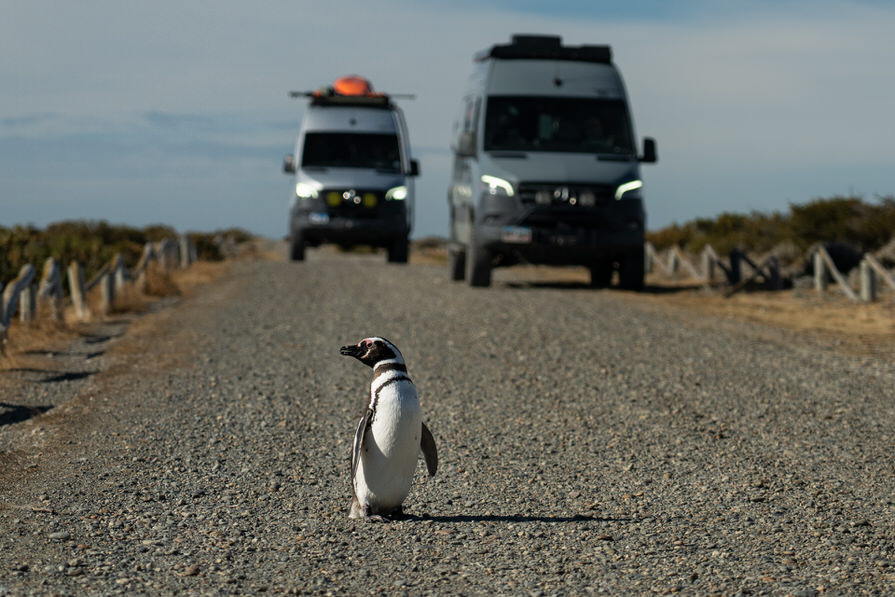 We drove 40,000 miles to find a penguin crossing the road. It was worth it.
You can read an overview of our Pan-American journey in our camper van in this article. And check out our many videos from this amazing road trip in this playlist on our Famagogo YouTube channel.
If you are considering driving the Pan-American Highway in your camper van or overlanding vehicle, here are some of the top questions we have been asked about this epic road trip, and our honest input having completed it …
1. What Is the Pan-American Highway and Where Does It Go?
The Pan-American Highway is a documented route running from Deadhorse, Alaska, down into Chile. However, it's more a general term for driving the length of the Americas than a single road everyone follows. Most travelers spend time on the actual highway but also deviate to explore points of interest along the way.
Many people (us included!) consider it to officially start in Deadhorse, Alaska, and end in Ushuaia, Argentina. However, there are a few variations, and individual countries claim various sections of it. There's even an official end of the route in Chile, but it's commonly understood to continue all the way to the bottom of Argentina.
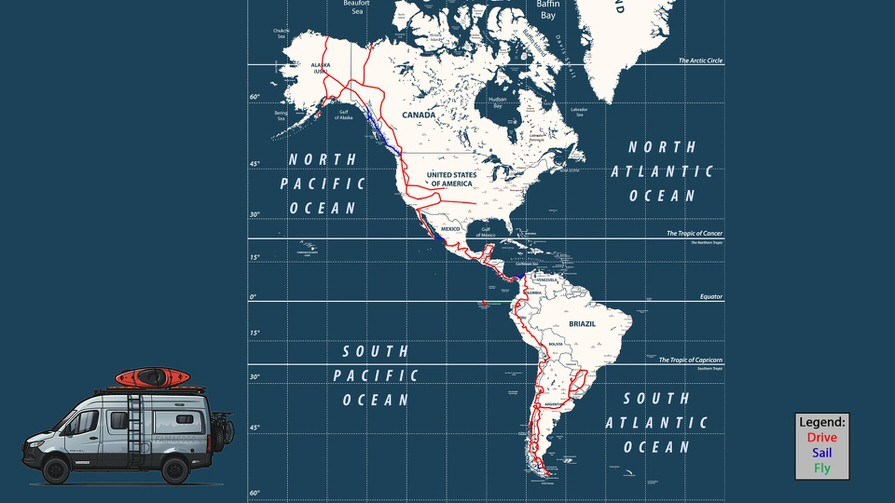 This is the map of our route traveling the Pan-American journey.
2. How Long Does the Pan-American Journey Take?
When traveling the Pan-American Highway from Alaska to Argentina, you will cross through 14 countries and drive close to 20,000 miles (assuming you don’t make side trips!).
While some travelers can do it in closer to six months, the journey took us almost two years. Including our wanderings in the Arctic, we were near 40,000 miles by the time we got the Revel home.
3. What Is the Best Vehicle for Driving the Pan-American Highway?
There is no one “best” vehicle option for driving the Pan-Am or overlanding in general, but the 4x4 Winnebago Revel has been the perfect blend of comfort and capability for us. It carried the three of us, with our daughter Abigail, through Europe, and it's still a wonderful fit for Kathy and me now that she's flown the coop as an adult.
At just 19 feet long, it fits in a normal parking space and handles tight, congested cities with ease, while its 4x4 capability takes care of the rough stuff. Anything larger would have limited where we could go, both off-road and in cities with narrow streets.
While 4x4 is not strictly required on the Pan-Am, it definitely helps—especially on rough side trips and remote tracks. However, travelers have done this route in 2WD vehicles and even motorcycles!
Since we like off-the-beaten-path explorations, we decided to add some gear for exploring South America, including:
- the Agile Off-Road Rip Kit suspension upgrade
- a 28-gallon auxiliary fuel tank
- off-road lighting and perimeter lights
- an onboard air compressor
- upgraded RoamRig battery/charging system
- a Warn Winch
- full Agile skid plates
- a full-sized spare tire
- Midland Radio
- a permanently mounted Starlink on the roof
Fun Note: The perimeter lights were handy to scare off a Kodiak brown bear that attacked the Revel one night in Alaska.
 Kathy using our ARB onboard air compressor to re-inflate our tires after crossing the wild and remote off-road Lagunas Route from Bolivia into Chile.
4. Why Start the Pan-Am Journey in the Arctic?
You can choose to go north to south or south to north when taking on the Pan-American Highway depending on weather, your timeline, and other preferences.
For us, starting our Pan-American Journey up north in the Arctic was really exciting. It gave us a sense that we were headed somewhere far-flung and off the beaten path. We had always wanted to drive to the Arctic Ocean, so reaching it at Tuktoyaktuk was special. It was also nice to choose a place we could drive to and not have to start by shipping the van to our starting point.
On our first stop after making it up the Dalton Highway to Deadhorse, AK, we actually broke an axle. We spent an unforgettable week there, flying in a replacement and swapping the axle for the first time, on the side of the road in snow and mud, all while keeping watch for grizzly bears and even a polar bear that had been seen roaming the area.
Getting through that gave us the confidence that whatever the Pan-American threw at us, we could figure it out. It might not always be fun, but we could persevere. Looking back, it was one of the most exciting parts of the whole trip!
 It felt like a great achievement to drive all the way to the Arctic Ocean twice in two weeks.
5. What Are the Benefits of Traveling the Pan-Am in a Two-Van Convoy?
Along our Pan-American adventure, we joined our friend George in San Diego. He was committed to going at least to mainland Mexico with us, but as we crossed from Belize to Guatemala and on to Costa Rica and Panama, it became clear he'd be coming the whole way, which suited us perfectly.
Traveling as a convoy of two identical vans gave us a little extra safety and presence at military and police checkpoints. Even in rougher areas, including cartel territory, we were seen not as a threat but as a curiosity. People came up to talk, fascinated by our story and our vans, and that led to some really interesting conversations.
Two vehicles gave us freedom without complicated logistics, which can get unwieldy with five or more. We loved it, and we plan to travel across Africa with George in the years to come.
 The two Revel vans at the Equator in Ecuador. This also felt like a huge step crossing into the Southern Hemisphere.
6. Is It Safe to Drive the Pan-American Highway?
We get asked about safety on the Pan-American Highway a lot. In our experience … yes, it's safe. The only theft on the whole journey was our bicycles being stolen in Huntington Beach, CA. In a few areas, we started on high alert, but we quickly realized things weren't dangerous, just very different from what we're used to.
In certain places, we did choose to stay in overlander campgrounds rather than wild camping. That turned out to be a bonus, because we met northbound travelers who shared favorite places and recommendations we'd never have found otherwise. Once we reached Peru, Bolivia, Chile, and Argentina, we found plenty of amazing wild camping, much like in the USA.
We believe that the Pan-American isn't a trip to be feared; it's a trip to be enjoyed.
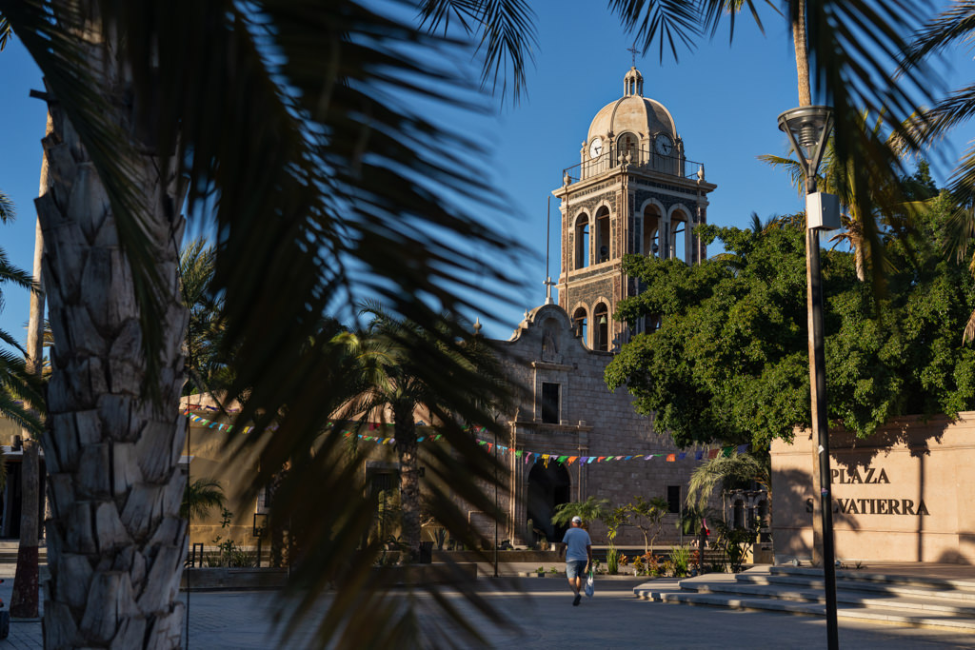 The square in Loretto, Baja, Mexico. It feels very safe and much like a European colonial city.
7. How Did You Get Across the Darién Gap?
If you have begun research on this trip, you may already know that you can not drive the entire Pan-American Highway continuously due to the Darién Gap.
The Darién Gap is a roadless area of dense rainforest between Panama and Colombia known for criminal activities, like human and drug smuggling. To get around this area, you must ship your vehicle, and it is costly at about US$8,000-10,000.
In Colón, we loaded the vans onto a ro-ro (roll-on, roll-off) ship bound for Cartagena, Colombia. The crossing takes about a week, and once the vehicle clears customs and security, the shipper calls you to pick it up. There's some bureaucracy, but it isn't hard. For ourselves, we sailed for five days through the San Blas Islands, snorkeling and swimming and visiting nomadic island communities that move from island to island with the fishing and the seasons.
 We took a sailboat from Panama to Colombia. This allowed us to visit the San Blas Islands. Locals live a traditional subsistence lifestyle, with fishing and moving from island to island seasonally in dugout canoes.
8. Is it Difficult to Cross Borders on the Pan-American Highway?
Many people expect it to be expensive and complicated to cross borders in Central and South America, especially with your own vehicle. But that is far from the truth. Most crossings are like driving from the U.S. to Canada.
When crossing borders on the Pan-American Highway, you will clear immigration and get your passport stamped, then import your vehicle with a temporary import permit. All you need is a copy of your registration (and sometimes your title), your driver's license, and your passport. Permits typically last 30 to 90 days, and some are longer. At the next border, you cancel the permit, get stamped out, and repeat the process in the next country.
Most crossings took us an hour or two. Complicated ones like Nicaragua took six to eight hours. The key is to approach border-crossing days with patience—stay positive, ask questions, and be helpful. We thought it became a fun part of the trip.
Are visas necessary? Only Bolivia required us to get an official visa during our trip. We got it at the border at a little shop that took our photo. The visa filled a full page of the passport. (Note that the rules have changed recently: As of December 2025, U.S. citizens no longer need a visa for Bolivia.)
 Crossing the Peru/Bolivia border was done by these memorable ferries crossing Lake Titicaca.
9. Do You Need to Know Spanish to Travel the Pan-American Highway?
You can do the entire Pan-American without knowing Spanish, but you'll have a much richer experience if you do. You can talk with locals and understand more of what's going on around you with at least conversational Spanish.
We started with just enough survival Spanish, picked up more as we traveled, and used Duolingo as a tutor. And my one complaint about the trip is that I wish I'd known more. I had to cut short many conversations because I didn't know what was being said or how to reply.
Our friend George would say: “We were traveling through South America with the vocabulary of a five-year-old,” and we had about a five-year-old's understanding of what was going on around us as well. But we did find many younger locals who spoke English and loved practicing with us by answering our endless questions.
 Agua Verde was our favorite off-the-beaten-path camp in all of Mexico. The little Spanish we knew was enough for a local to tell us how to get there on a two-hour dirt-road drive to the coast.
10. How Much Does It Cost to Drive the Pan-American Highway?
We spent about $2,500 to $3,000 a month traveling the Pan-American in our camper van, and that held for the whole trip. The exception was shipping the vehicles, the most expensive part, both around the Darién Gap and back from Buenos Aires to the USA. Each shipping leg was $8-$10K, with RORO costs, hotels, flights (sailboat charter), and other miscellaneous expenses.
Our biggest regular expenses were fuel first, food second, and campgrounds third. When we came home, we found that we were spending far less than we would living normally in the United States. Food, fuel, and most everything else are generally half price or better, with a few exceptions. It's possible to do this trip for less than it costs to live at home.
 The Mano del Desierto (Hand of the Desert) in Atacama Desert, Chile.
11. What Were the Most Challenging Roads of the Pan-American Trip?
Two roads come to mind as the wildest of the Pan-American journey. The first was the Colombian Death Road (El Trampolín de la Muerte): a one-lane road with two-lane traffic through a remote part of Colombia. It frequently washes out, with sheer drop-offs and waterfalls pouring onto the road. Dense truck traffic on narrow ledges with thousand-foot drops tested our nerve. It's not for the faint of heart, but I'm so glad we did it because it showed us a wonderful part of Colombia.
The second was Peru's 3N. Most overlanders take the coastal route, basically a long, dirty highway, but the 3N takes you through the mountains to remote villages and up into the Andes and the Cordillera Blanca. Some days, it took us 10 hours to go 120 miles, but we loved this section and found it fascinating.
 El Trampolín de la Muerte (Colombian Death Road) took the prize for the wildest road.
12. What Was Your Favorite Place & Where Did You Have the Best Food?
My favorite was Patagonia, the whole region from the Lakes District down to El Chaltén and Torres del Paine. That whole area was magical. Kathy would say hers was the Galapagos Islands, a side trip we flew to from Ecuador, which was amazing as well.
For food, all three of us, George included, would say Mexico had the best. We loved eating at little roadside eateries along the way, and the tacos were incredible.
 Peter had dreamed of exploring Patagonia for nearly 30 years. This was his favorite moment of the whole trip, seeing Fitz Roy and Cerro Torre on the horizon.
13. What Would You Do Differently on the Pan-American Journey?
Honestly, I feel like we had the perfect Pan-American trip, and we loved every moment. The only thing I might change is taking another year, because there are always places we missed, and we definitely have some on the wish list to visit again.
I'd love to spend more time in Patagonia, moving slower and really taking it in. Kathy would want to go up to Brazil to see the jaguars in the Pantanal, and George would probably want more time on the coast. We have some very good reasons to go back and do it all over again, and I hope we can someday.
 This is the southernmost end of the Pan-American Highway, Ushuaia, Argentina. It felt a little anticlimactic to get to the bottom; it proves it’s really about the journey, not the destination.
Do you have more questions about traveling the Pan-American Highway? Please ask in the comments, and we will do our best to answer!
Comments
Comments on this post are moderated, so they will not appear instantly. All relevant questions and helpful notes are welcome! If you have a service inquiry or question related to your RV, please reach out to the customer care team directly using the phone numbers or contact form on this page .