The Myth of the Perfect RV Trip & How to Manage Expectations
The Myth of the Perfect RV Trip & How to Manage Expectations
Get insights on what the bumps in the road can teach you.
By: Morgan Field
I'm Morgan Field, traveling part-time in my 2019 Winnebago Travato 59K with my pup-pilot Teddy—a Pittie with a million-dollar smile.
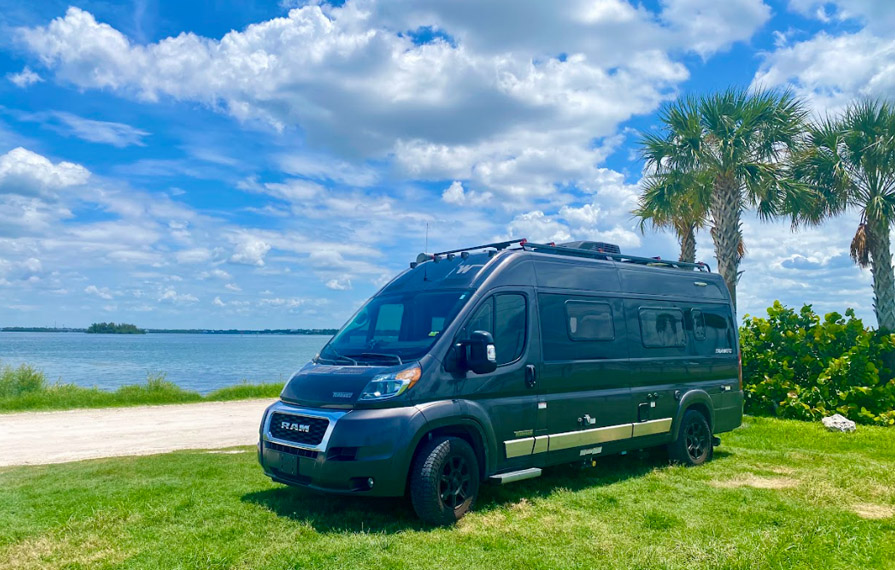
There's a version of RV travel that lives on Instagram: the golden-hour light dancing across a lake; a perfectly parked rig overlooking the ocean; morning tea in hand as the world slowly wakes up around you. The kind of moments that make you pause and think, I can't believe this is real.
And here's the thing ... those moments are real. The awe absolutely happens.

But so do the reroutes, the breakdowns, the weather delays, the wrong turns, and the days when you're running on fumes and wondering whose idea this was in the first place.
The magic of RV life isn't that it protects you from those stressful moments. It's that it invites you to move through them without losing your sense of wonder, joy, or aliveness.
Because underneath all of it, something deeper is happening: the parts that don't go according to plan aren't interruptions to the journey. Those moments are the journey … offering lessons, redirections, and strangely beautiful moments of clarity you don't get when everything goes smoothly.
The people who actually thrive in this lifestyle aren't the ones who avoid fear or uncertainty. They're the ones who learn how to dance with it. And there are some helpful tips you can keep in mind for doing just that!

1. Know Your Bandwidth (and Stop Before You Hit Empty)
Some travel challenges are accidentally self-inflicted. Every RVer has a version of this story: you push a little too far, can’t find a campsite, you’re exhausted and decision-fatigued, and suddenly the whole trip feels like a mistake.
That’s not failure. That’s a system at capacity.
One of the most important skills in this lifestyle is learning your bandwidth—your driving limits, your emotional capacity, your decision-making threshold—and honoring it before you hit depletion. Not at the edge. Before it.
This might mean a three-hour driving limit. It might mean staying an extra night in a place that feels good instead of chasing the next destination. It might mean taking a full reset month. No travel, no upgrades, no maintenance projects … just space to breathe again.
One of the surprising truths about freedom is that it still requires care. Not control. Care.
The RV runs on battery management. So do you. When I finally learned that, everything softened. Burnout stopped being something that “suddenly happened,” and it started becoming something I could actually prevent. And prevention is a form of self-respect.

2. Remember Things Will Break, But You Will Become More Capable
Your RV is a home experiencing constant motion: things loosen, systems glitch, and unexpected warnings appear.
And at some point, something will break in a way that feels like the world is collapsing. For me, one of those moments was getting stranded in a Walgreens parking lot when my ESC light came on, and the vehicle wouldn’t shift into gear.
What felt like a disaster turned out to be a faulty brake light switch. Not the catastrophe my mind had written. Just a problem, and one I could handle.
I also learned the hard way that carrying a diagnostic code reader saves a bazillion hours of mental gymnastics. Instead of spiraling through worst-case scenarios, you can often get clarity in minutes.
Preparedness doesn’t eliminate chaos. But it does reduce the time you spend inside the story your fear is trying to write. Remember to pause before panicking because most things are not emergencies. They are invitations to slow down and respond instead of react.
Read my tips for keeping up with RV maintenance without the overwhelm!

3. Anchor Yourself with the Familiar
One of the most grounding travel practices I've found (and one that helps me navigate the constant change that comes with life on the road) is weaving familiarity into the adventure.
Here are some ideas I love:
- Stop at a favorite restaurant where you already know what you’ll order.
- Visit a campground brand you trust.
- Create a morning routine you repeat no matter where you wake up.
- Go to a state park that feels like a return instead of a discovery.
These anchors don’t reduce adventure; they stabilize your nervous system so you can actually receive it.
When everything is new, nothing gets fully absorbed. Familiarity creates space for wonder to land.

4. Try Out an RV Dog’s Way (A Different Kind of Wisdom)
My pup-pilot Teddy has never once cared that a campsite reservation fell through. He doesn’t know what rerouting means. He doesn’t worry about timelines or logistics or whether we’re “behind.”
Give him a patch of grass, a new trail, a warm sunbeam, and something interesting to smell, and the day is a wild adventure. There are so many moments when I realize he’s actually the better traveler because he never leaves the present moment to go negotiate with fear.
He just lives the day he's been given. Fully. And somehow, in doing so, he reminds me that maybe the point was never to control the adventure—only to experience it. (Read my tips for RVing with a dog here!)

5. You Don’t Have to Go Big to Be on an Adventure
Some curveballs on the road are mechanical; others are simply expectations colliding with reality.
It is best to let go of the belief that a "real" RV trip has to be longer, farther, more adventurous, or more impressive than the one you're taking. Or that if you're not crossing multiple states, checking off bucket-list destinations, or spending weeks on the road, somehow it doesn't count.
Some of the most meaningful RV moments aren't epic cross-country journeys; they're the small ones:
- A weekend thirty minutes from home.
- A quiet campsite after a hard week.
- A spontaneous local farm stay where you feed alpacas and laugh more than you expected.
- A morning where nothing is planned, and nothing needs to be.
These count. These are worth the trip! Sometimes the shift isn't in the destination; it's in our perception of what makes a journey meaningful in the first place.
Don't let comparison blind you to the magic that's already available to you. Because the point was never to travel the farthest. The point is to be present enough to experience where you are.

6. When it Gets Hard, Don’t Quit on Your Joy
There will be moments when everything feels like too much: When something breaks. When the check engine light comes on. When you're tired. When fear gets loud. When you're questioning whether any of this is worth it.
If that happens, let it move through you. Cry. Vent. Rest. Step away if you need to.
But don't make permanent decisions from temporary overwhelm. Instead, come back to why you started, not the curated version of RV life—the real one.
- The one where a stranger at a campsite becomes a lifelong friend.
- The trip where your dog discovers joy in the smallest things and reminds you to do the same.
- The one where a random Tuesday becomes a memory you'll talk about for years.
- The trip where you wake up, pull back the shades, and think: I get to be here.
- That feeling is the point. Not perfection, but aliveness. That's why you do this.
And if you're counting the hard parts, make sure you're counting the good parts too. The morning tea with a view, unexpected kindness from a stranger, a sunset you almost missed, and the laugh-until-you-cry moments that never made it onto the itinerary.
Because what you focus on expands. Gratitude journaling isn't a cliché—it's a reorientation. It shifts what you're looking for, which changes what you see.
And sometimes gratitude isn't about denying the hard things; it's about refusing to let them erase the good ones.

The Truth About the “Perfect RV Trip”
Somewhere along the way, someone said, “Wherever you go, there you are.” And that's true. You don't escape yourself on the road. But you do discover things about yourself that everyday life has a way of hiding.
Your fears, resilience, capacity for wonder, ability to figure things out, and (perhaps most importantly) your ability to be fully alive in the middle of an imperfect journey all shine through when RVing.
And maybe that’s what the “perfect trip” was all along. Not a trip without problems, or a trip where everything went according to plan. But a trip that left you more alive than when you started.
The road was never asking you to do it perfectly; it was simply inviting you to show up for the journey.
—Morgan & Teddy (Follow along on Instagram @themorganfield or on Facebook.)
Want more travel insights? Read why Morgan thinks solo RV travel is so empowering!
Comments
Comments on this post are moderated, so they will not appear instantly. All relevant questions and helpful notes are welcome! If you have a service inquiry or question related to your RV, please reach out to the customer care team directly using the phone numbers or contact form on this page .