
How Long Can You Boondock in Your RV? 7 Things to Consider
How Long Can You Boondock in Your RV? 7 Things to Consider
Tips for calculating your boondocking time and extending it!
By: Brooke Baum
Calculating how long you can realistically stay off-grid before your boondocking trip can help you have the relaxing, peaceful escape you are dreaming of instead of being constantly concerned about your essential resources. Planning ways to limit your usage beforehand can also help keep you on track, so that you aren’t forced to return to town before you want to!
Knowing how long you can boondock in your specific RV and with your resource needs will also help you choose how far off-grid your campsite can be and how much food to pack.
Are you a boondocking beginner? Read this guide and watch this video tutorial to learn more!
 Boondocking in a Winnebago EKKO. (Photo by James and Stef Adinaro.)
What Limits How Long You Can Boondock?
When planning your boondocking RV trip, consider these limitations to create a realistic timeline for how long you can be off-grid while remaining comfortable and avoiding potential issues.
1. Freshwater Supply
RV water usage when boondocking is a key concern for RVers planning their off-grid camping trips. The size of your freshwater tank is one of the main limiting factors when considering how long you can boondock, since you use it for drinking, cooking, washing dishes, showering, and flushing the toilet. So, it adds up quickly—especially if you are traveling with multiple people.
Freshwater tank capacity varies by RV, but Class A and Class C motorhomes and larger travel trailers will generally have the largest tanks. (Read about the perks of boondocking in a Class A motorhome.)
 Boondocking in a Winnebago Vista. (Photo by Kenny & Sabrina Phillips.)
Ways to extend freshwater usage when boondocking:
- Take short “Navy” showers
- Use disposable wipes or dry shampoo between showers
- Pre-cook meals before your trip to avoid water usage for cooking and washing
- Eat low-mess foods and wipe dishes before washing to limit dish water
- Limit toilet flushing
With a little extra intentionality, you can limit your water usage more than you may expect!
2. Available Power
Turning on lights, running the furnace and fridge, charging devices, and other everyday tasks all rely on your RV batteries. Depending on your power setup, you may only be able to realistically boondock for a few days before needing to plug in again. However, with solar and lithium power, you could potentially boondock until your other resources run out! (Learn more about RV solar power in this video tutorial.)
 Winnebago Travato solar setup.
Solar power often removes electricity as the limiting factor for boondocking (as long as your power needs are not extreme) because it continuously recharges your RV batteries during daylight instead of relying on a fixed battery supply. Just keep in mind that cloudy days can affect the solar charging. Lithium batteries are also a popular option for boondockers because they make your RV’s electrical system more efficient and reliable, especially when paired with solar power. (Learn why RVers love lithium power!)
Many RVs also have generators, but it is considered poor etiquette (and sometimes against local rules) to run a loud generator in quiet natural areas. If you have appliances that use propane for cooking or heating your RV, you should also consider if you will have enough propane for your boondocking trip.
Ways to extend power usage when boondocking:
- Avoid using your air conditioner and other high-draw appliances
- Limit furnace use (the fan is a high-power drain)
- Optimize solar power by parking in full sun
- Switch to LED lights
- Charge devices during daylight
- Use portable power banks for smaller electronics
Winnebago Connect, now available in Winnebago View/Navion models, makes monitoring your power usage simpler than ever. Learn more.
 Boondocking in a Winnebago View on the beach.
3. Space in Waste Tanks
Depending on your RV, you are likely to have both a black and gray water waste tank. The gray water tank typically fills faster because it collects water used for showering and using sinks. Dishwashing or showering without paying close attention to water usage can end a boondocking trip early, even if you still have fresh water left. While it usually takes longer to fill your black tank, since it only contains waste from the toilet, it can still become a limiting factor for larger families or longer stays.
Ways to limit waste tank usage when boondocking:
- Take short showers and limit dishwashing
- Catch cold water while you are waiting for the shower water to get hot and reuse it to wash dishes or in other ways
- Limit toilet paper usage and flushing
Note that RVs with portable or cassette toilets have smaller black tanks; however, these can be transported separately to a dump station if you travel with a car, so that you don't have to break camp.
 Boondocking in a Winnebago Revel. (Photo by Peter & Kathy Holcombe.)
4. Legal Stay Limits
It is important to respect laws and local rules for boondocking so that it can continue to be an option for RVers and other campers. While some spots allow for unlimited use, many boondocking areas have stay limits of 14 days, especially on Bureau of Land Management or National Forest land. Even with unlimited resources, local regulations can necessitate a change of camping site, so it is important to research the rules before your trip.
Be sure to also make sure your RV is capable of getting to the boondocking spot you plan to camp in! You may need an off-road-capable vehicle, like one of Winnebago’s Backcountry Series RVs, to get there safely. (Read how one couple planned their first boondocking trip with their travel trailer!)
It is important to always follow Leave No Trace Principles when boondocking as well—even if they are not explicitly posted.
 Boondocking in a Winnebago Micro Minnie travel trailer. (Photo by Becca & Brian Roy.)
5. Food Supplies
If your goal is to stay off-grid for as long as possible without trips to the nearest town to restock, bringing enough food for your trip is key. Limited fridge and pantry space can make it difficult to bring everything you need. However, with creativity in your meal planning and prepping, you can easily overcome this challenge!
6. Weather Conditions
More extreme weather can affect how much you use your appliances and how much power you use. Cold weather increases furnace use, while hot weather will likely make you want to run your air conditioner much more. Keep possible weather variations in mind when planning your boondocking trip.
 Boondocking in a Winnebago Journey. (Photo by Scott & Jaime Sichler.)
7. Comfort Considerations
Choosing a comfortable camping site for boondocking is also important for planning a longer stay. Even with all the resources you need, you may decide to leave early if the area is too crowded, is too shaded to make good use of your solar panels, or has limited connectivity.
You should also keep general personal comfort preferences in mind:
- Are you okay taking quick showers to limit water usage?
- How long can you go without air conditioning?
- Could you limit furnace use, if needed?
- Do you need connectivity for work or lifestyle preferences?
- Are you comfortable monitoring and limiting your power and tank usage?
- Do you have any safety concerns about being off-grid for an extended time?
Sometimes the limit isn’t your RV—it’s how comfortable you are staying off-grid.
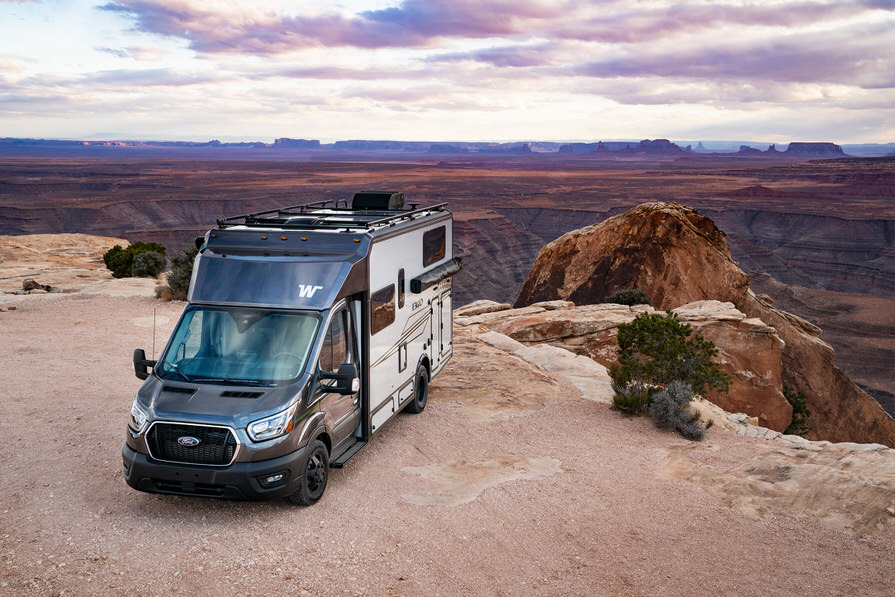 Boondocking in a Winnebago EKKO.
How to Calculate Your Resource Usage for Boondocking
If you want to know how long you can stay off-grid in your RV, start paying attention to how much water, power, and other resources you use on a normal full-hookup camping trip. Then challenge yourself to limit that usage to the minimum you are most comfortable with.
For freshwater usage, divide your tank size by your total daily water usage (for everyone traveling with you) in gallons to get an estimate on how many days you could potentially boondock. You could also bring a few additional jugs of water along for your trip, if needed. But you also will need to keep your RV’s carrying capacity in mind.
For battery usage, it is important to understand your RV’s power setup, how much usable capacity you have, and how much power each of your appliances takes to run. If you don’t have lithium batteries or solar power and want to boondock often or for longer periods, it may be worth upgrading to have more power available. If you have solar power, calculate how much estimated recharge you can expect and make sure that is enough to cover your daily use expectations.
For waste tank usage, remember you should always empty your waste tanks in the appropriate facilities, so you may need to break camp to do so if these get filled quicker than expected. To get an accurate estimate on how much tank space your family will fill per day, you could simply go without hooking up for a few days at a campground and assess where your tank levels are. Pay attention to ways you could limit your usage during this time to maximize your tank space when boondocking!
 Boondocking in a Winnebago Revel. (Photo by Peter & Kathy Holcombe.)
As you begin boondocking, continue to track your usage to get more confident in your estimates and find more opportunities to limit your resource consumption. Soon, you will be a pro with creative tips of your own for prolonging off-grid stays! And remember that there is no shame in a quick trip to town to dump your tanks, get more fresh water, refuel, and restock. The wild places will be there waiting for you to return!
Comments
Comments on this post are moderated, so they will not appear instantly. All relevant questions and helpful notes are welcome! If you have a service inquiry or question related to your RV, please reach out to the customer care team directly using the phone numbers or contact form on this page .