
Buying Your First RV? Don’t Skip These Steps
Buying Your First RV? Don’t Skip These Steps
Balancing the excitement of RV shopping with realistic plans.
By: Kenny & Sabrina Phillips
Sabrina and I bought our first RV in 2017, and I remember it as if it were yesterday—that’s how exciting the experience was. We were going from RV show to RV show, dove into RV forums and chat rooms, and asked our favorite YouTube creators very newbie questions after watching their walkthrough videos, then eagerly waited for their replies (looking at you, We’re The Russos!). If there was a way to learn something about RVing, we were in.
Yes, RV shopping and learning about RV life is exciting … but it can also be stressful.
Buying an RV is a significant financial decision. If you don’t get it right, you could lose thousands by trading it in for a different model later. And, if you are a new RVer, it can be challenging to know what to look for. However, the good news is that a little preparation can prevent expensive lessons down the road.

So, let’s walk through a few key steps to help you buy your RV with confidence …
1. Shop Smarter, Not Faster
This is worth repeating: don’t rush through the shopping process.
Sabrina and I spent over two years shopping for an RV, and I believe that time investment helped us make one of the best decisions we could have made when we landed on our Winnebago Vista. Owning the same RV for nine years isn’t that common, but it shows how seriously we took the shopping experience.
Here’s what we did while RV shopping to choose the best RV for us …
We went to RV shows, big and small. We brought a notepad and wrote down the brands and models we liked, the floorplans, and what stood out most about each one. We also “played house” in every RV that caught our attention, pretending to move through our daily routines. That exercise helped us eliminate options quickly.
If there wasn’t a place to hang clothes, if the pantry wasn’t large enough, or if I couldn’t stand in the bathroom and realistically simulate shaving, that floorplan was out. Attending shows also allowed us to see multiple models side by side in real time, making it easier to compare brands and evaluate material quality.

However, our secret weapon for RV buying success was renting before buying. After narrowing down brands and floorplans at RV shows, we rented a Class A. At the time, you basically rented what was available, so we couldn’t get the exact brand or model we wanted, but it was at least the right style. Today, platforms like Outdoorsy and RV Share make it much easier to rent something closer to what you’re considering. (You can also check if your local Winnebago dealer has the model you are interested in available for rent on this page.)
For us, that rental solidified our decision that a Class A was the right fit. But, the one we rented was 35-ft long, which taught us that we didn’t need something that large for just the two of us. It pushed us to start looking at shorter Class A models, and our 28-ft Vista has been perfect for us. After the rental experience, we were back to the shows with even more clarity and a better understanding of how all the RV systems operate.
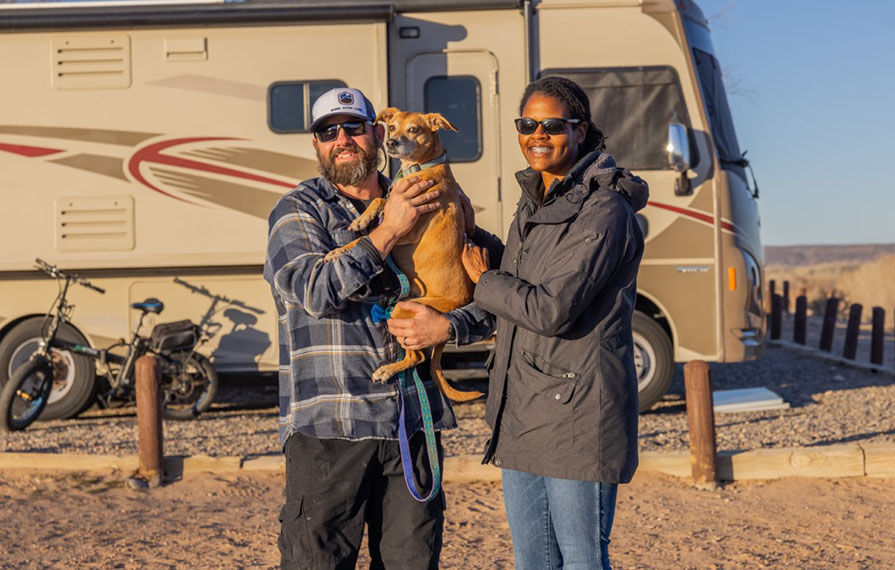
 Sabrina happy to be camping with our Winnebago Vista.
When shows weren’t happening, we visited dealerships. The experience was similar, though not quite as relaxed. At shows, browsing feels natural. At dealerships, the pressure to purchase can feel higher. That said, Sabrina and I have no problem letting a salesperson know we’re only looking. We actually found it helpful to talk with different sales teams and observe how each dealership handles the buying process. Some charge fees, some waive them. Some negotiate heavily, others take a no-nonsense approach. Every dealership operates differently.
One more tip: bring a grounded friend. It may sound simple, but having someone with you, especially someone who isn’t completely sold on the RV lifestyle, can be incredibly helpful. It’s easy to romanticize the idea of travel and overlook practical flaws. A skeptical friend or family member will quickly point out what might not work and help keep your vision rooted in reality instead of fantasy.
For more insights on how to choose the best RV for you, read this article.
 Test driving the Winnebago Adventurer.
2. Find Your Budget & Stick With It
This is usually the least exciting part of shopping: creating a budget.
I remember when Sabrina and I were working through ours, she kept saying, “I feel like this budget keeps telling me no.” I told her she had to look at it differently. Instead of focusing on what it wouldn’t allow, we needed to focus on what it did allow us to get.
That shift in mindset isn’t always easy. There will always be features that fall outside your budget: heated floors, a dishwasher, and luxury upgrades that look incredible on the showroom floor but come at a premium price. Those options are appealing, but they are not always budget-friendly.
Having a clear budget in hand keeps you focused and prevents you from getting in over your head. You want to make a purchase you can enjoy for years to come. If you stretch beyond what you can comfortably afford and later realize the RV is too expensive to maintain, selling it can mean taking a significant loss.
You might wonder how someone ends up over budget in the first place. Often, it’s not the purchase price alone; it’s the additional costs that sneak up on you—maintenance, fuel, campground stays, storage, insurance, and the cost of exploring new places. These expenses are part of the RV lifestyle, and they can be overlooked during the excitement of shopping.

3. Understand Your Purchase Options & Find the Right Dealer
When it comes to the actual purchase, you will need to decide if you should pay cash or finance. Should you buy new or used?
These are personal decisions based on your financial situation and comfort level. What I will suggest is this: shop around for financing rates. Compare what the dealer offers with outside lenders. Understand the full cost of the loan, not just the monthly payment.
It’s also important to remember that RVs typically depreciate over time, with the steepest drop often happening in the first year. For this reason, Sabrina and I chose to purchase slightly used. We put down as much as we comfortably could and committed to paying off our fifteen-year loan in just three years. For us, that strategy made sense. (Note: I’ll share more on choosing a used vs. new RV in a future article, so feel free to ask any specific questions in the comments!)
 Testing out a Winnebago Travato.
Once you’ve decided on the right RV, the model year, and how you plan to pay for it, the next big question becomes: where do you buy?
There are thousands of RV dealerships across the United States, which can make the decision overwhelming. You may be tempted to shop only locally, and that’s perfectly reasonable. However, I strongly recommend expanding your search beyond your immediate area to make sure you’re not missing a better match or a better price.
When Sabrina and I bought our RV, we were living in Virginia but ended up purchasing in Ohio, roughly 500 miles from home. We found the exact Winnebago Vista we wanted at a price that was nearly $10,000 less than similar models elsewhere in the country.
That kind of price difference raises questions: Why is this one so much cheaper? Is it truly a great deal, or is there something wrong with it?
This is where a certified inspector and a reputable dealership make all the difference.
 Example from our RV inspection report.
4. Get an RV Inspection & Take Time for a Thorough Walkthrough
We didn’t want to make multiple trips between Virginia and Ohio only to discover the RV had major issues. So, we contacted the dealership, Shafer’s Truck and RV Sales LLC, and asked if they would allow us to hire a certified RV inspector to evaluate the unit on our behalf. They were completely accommodating and even plugged the RV into shore power and connected the water and sewer so the inspector could test every system properly.
We located an inspector through the National RV Inspectors Association (NRVIA), and he conducted a detailed inspection. If the dealership had refused to allow an independent inspection, we would have immediately walked away. I would encourage any buyer to do the same.
The inspector provided a clear, comprehensive report with photos. He identified only minor issues. We shared the report with the dealership, and they corrected every item before we completed the purchase. That level of transparency gave us the confidence to move forward.
We rented a one-way car from Virginia to Ohio, arrived at the dealership, and began our walkthrough with the sales team. They took their time explaining how each system operated. We asked questions and operated components ourselves. Nothing felt rushed.
When it came time to finalize the sale, there were no hidden fees. The invoice reflected exactly what was advertised, plus tax. It was one of the smoothest dealership experiences we’ve ever had.
This is what your buying experience should look like: transparent, thorough, and respectful of your investment. Take the time to verify the condition of the RV. Hire an independent inspector. Insist on a detailed walkthrough. When a dealership is confident in what they’re selling, they won’t hesitate to stand behind it.
5. Be Part of the Community
So now that you’ve bought your RV, what’s next?
I recommend joining one of the Winnebago owner groups. These communities are a great place to ask questions about your new-to-you Winnebago, learn about group events, and connect with other owners who have already taken the road you’re just starting.
Many of these Facebook groups have grown into large, supportive communities that are incredibly helpful for both new and experienced owners. One of the things I enjoy most is the meetups. They provide an opportunity to meet the people you’ve been chatting with online, tour each other’s RVs, compare modifications, and share lessons learned.
Being part of a community transforms RV ownership from simply owning a vehicle into being part of something bigger. It’s an excellent way to stay informed, build friendships, and fully enjoy the RV lifestyle. (Learn how to get more involved in the owner community in this encouraging article.)

Closing Thoughts on Buying Your First RV
Buying your first RV is an exciting milestone, but it’s also a major decision. Taking the time to shop carefully, set a realistic budget, hire an inspector, and insist on a thorough walkthrough can make the difference between a stressful experience and a smooth one.
The goal isn’t just to buy an RV. The goal is to enjoy it for years to come, with confidence in the decision you made and excitement for the road ahead.
Do your homework. Ask questions. Surround yourself with a strong community. And when the day finally comes to head down the road for that first trip, you’ll know you did it right.
Safe travels, everyone!
Comments
Comments on this post are moderated, so they will not appear instantly. All relevant questions and helpful notes are welcome! If you have a service inquiry or question related to your RV, please reach out to the customer care team directly using the phone numbers or contact form on this page .