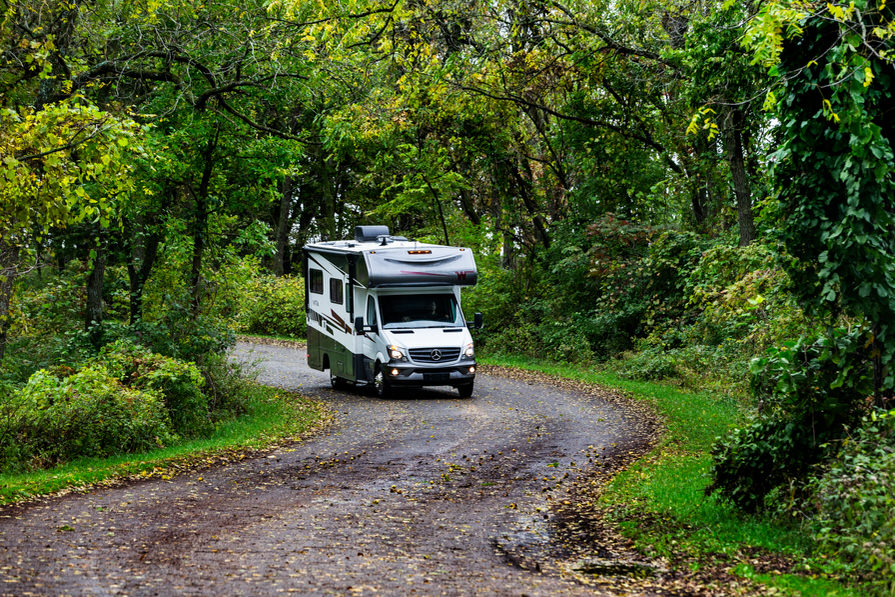
7 Important RV Driving Tips for Beginners
7 Important RV Driving Tips for Beginners
Skills to learn and ways to practice as a new RV driver.
By: Peter & Kathy Holcombe
Over the past 12 years of extended RV travel, Peter and I have shared driving responsibilities fairly equally. However, when we decided to drive the Pan-American Highway, we were suddenly faced with a whole new set of challenges—both behind the wheel of our Winnebago Revel and while navigating unfamiliar environments.
Because the learning curve was so steep, we decided to divide and conquer so we wouldn’t be overwhelmed trying to learn everything at once. Peter focused on learning the rules of the road and developing a heightened awareness for the unexpected. I concentrated on figuring out how to maneuver our large vehicle through a labyrinth of tiny village streets, low-hanging wires, and sudden detours.
When I did find myself behind the wheel, I rarely took the time to fully adjust the cockpit to my personal needs. The mirrors and seat were usually “close enough” for short stints. It wasn’t until I took an off-road driving course that I truly understood how much a properly adjusted cockpit affects both confidence, safety, and technical ability.

That leads to my first recommendation for anyone learning to drive an RV or larger vehicle:
1. Take the time to properly adjust your RV.
Adjusting your RV for driving starts with your seat and steering wheel. You should be able to comfortably reach the pedals and steering wheel without strain. All controls should feel like a natural extension of your body. The same goes for your mirrors. They should be adjusted so that you only need to move your eyes—not your head or body—to scan the entire perimeter of the vehicle.
Some vehicles offer multiple driver settings that allow you to save your preferences and recall them with the push of a button. Since our Revel does not, I can usually “make do” by tilting my head slightly to see the mirrors and reaching the pedals without much adjustment. For a long time, I convinced myself that it wasn’t worth the effort to reset everything. But what I learned in driving school is this: a properly adjusted cockpit allows you to perform advanced maneuvers confidently and safely, without shifting your body or double-checking blind spots.

Make the time to properly adjust your vehicle before driving for the safest and most comfortable experience. It is your responsibility to adjust everything before putting the vehicle in gear—even if your partner grumbles about having to readjust it later.
2. Learn the perimeter of your vehicle and identify blind spots.
There is a simple exercise you can do with a partner that will dramatically increase your confidence when driving a larger vehicle.
First, sit comfortably in the driver’s seat with the seat, steering wheel, and mirrors properly adjusted. Have your partner stand directly in front of the hood. Without moving your body, ask them to slowly walk backward until you can see their feet. You may be surprised by how far back they need to go before you can see them fully.
Have your partner place a rock or marker on the ground where they were standing. Then, with their guidance, pull the vehicle forward until the front bumper reaches that mark. Repeat this exercise until you are confident in your ability to judge distance to an object you cannot see. This builds confidence for parking and avoiding obstacles in front of your vehicle.
Next, repeat the exercise at the rear of the vehicle. Finally, have your partner stand at each of the four corners and along the sides of the vehicle so you can identify exactly where the edges and blind spots are without moving your head or seat position.
Practice until you know the perimeter of your vehicle instinctively.

3. Set yourself up for success when practicing.
When learning to drive, start in a wide-open space where there is nothing to hit. When our daughter Abby was learning throttle control and steering, we took her to a dry lakebed in the California desert—six miles of flat, smooth surface in every direction. That was an ideal situation, but a large shopping mall parking lot early on a Sunday morning works just as well.
The fewer things you have to worry about while learning, the faster your confidence will grow.
For specific tips for driving large motorhomes, read this article. (Note that Winnebago has also added a Driver Confidence Package in multiple Class A RVs.)
4. Learn how your vehicle starts, drives, and stops.
It takes time to learn how much pressure is needed on the gas pedal to maintain a steady speed, and how much distance and brake pressure are required to stop a large vehicle safely. Use your open practice area to experiment with starting and stopping so that when you encounter traffic or another issue, you already know exactly how your vehicle will respond.

5. Set up a DIY driving course.
Once you have good throttle and brake control, it’s time to practice maneuvering. An empty mall parking lot is perfect because lanes and parking spaces are already marked. If that’s not an option, use cones or rocks to create your own course.
Practice staying within your lane. Use your mirrors to see how close you can get to the center or outer edge without crossing the line. Practice turning—every vehicle tracks differently. Do you need to swing wider to avoid clipping a curb with the rear wheels? How does your vehicle track when pulling into a parking space? Will the rear swing wide enough to hit a nearby car?
Practice lane changes so you know exactly where the back end of your vehicle is and can change lanes confidently without over-checking your mirrors.

You can also sign up for a driving course if it is in your budget to get professional assistance when learning to drive an RV for the first time, or for gaining specific skills like off-road driving.
6. Start with a short drive on a real road.
Once you’re comfortable in the parking lot, it’s time to head out onto a real road. Again, set yourself up for success. Choose a wide road with a smooth surface and minimal traffic. Keep the drive short and manageable so you finish the task feeling successful rather than overwhelmed.
As your confidence grows, you can gradually tackle more challenging situations like heavy traffic, fuel stops, and tighter spaces.

7. Learn specific skills to safely pull a travel trailer.
Driving forward with a trailer is fairly straightforward and similar to driving a single vehicle. The same practice steps outlined above apply, with special attention to how the vehicle and trailer track together when turning corners. Parking lots are excellent places to get a feel for how the pair moves as a unit.
Backing up with a trailer, however, is a very different skill and requires practice.
When reversing a single vehicle, it’s simple: place your hand at the top of the steering wheel and move your hand in the direction you want the vehicle to go.
With a trailer, the steering input is reversed. A helpful trick is to place your hand at the bottom of the steering wheel. When you move your hand to the right, the wheel turns counterclockwise, and the trailer moves to the right. Keep your hand at the bottom of the wheel, and the trailer will follow the direction of your hand.

Remember: RV Driving Confidence Comes from Practice
Over the past 12 years, we’ve driven many different types of RVs and frequently pulled trailers. Every time I sit behind the wheel of a new vehicle, I still feel a flutter of nervousness. But here’s the truth: no one is born knowing how to drive an RV. It takes practice—lots of it. The more time you invest in learning in a safe, supportive environment, the more confident you’ll be as you head out onto the open road.
And with confidence and experience, you’ll be ready to handle the unexpected situations that inevitably arise—with skill and calm.
Comments
Comments on this post are moderated, so they will not appear instantly. All relevant questions and helpful notes are welcome! If you have a service inquiry or question related to your RV, please reach out to the customer care team directly using the phone numbers or contact form on this page .